
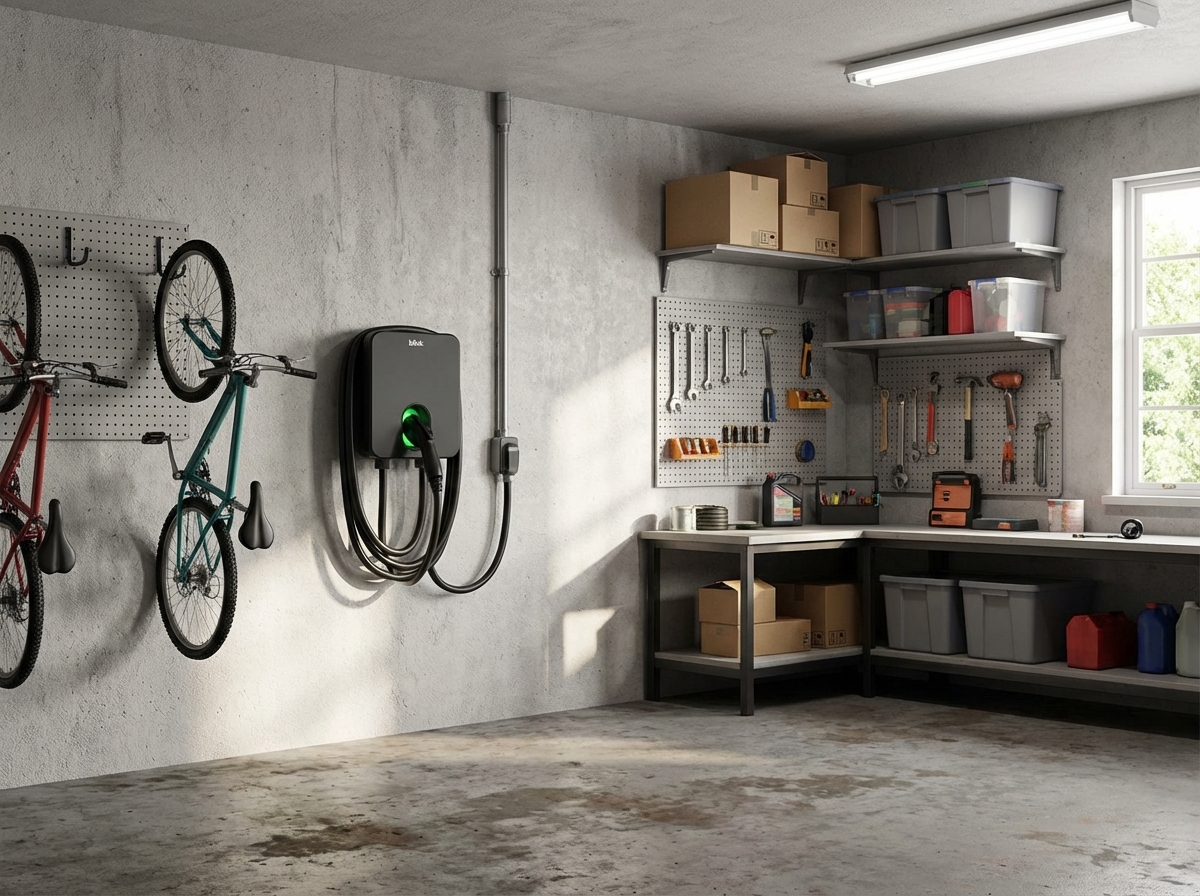
One of my recent conversations started the way these things usually do, leaning over a fence with coffee in hand. Our neighbors had just filled their Subaru SUV and were still a little stunned by the receipt. Gas prices do that. They reorder priorities quietly and all at once. They know we’re on our second EV now, and the questions came faster than I could pretend I hadn’t memorized the answers by heart.
- How much did it hit your utility bill?
- What did the charger actually cost?
- How often do you even plug the thing in?
Those questions are not theoretical anymore. For us, the EV adds roughly the cost of a couple of fancy coffees per month to our electric bill, depending on season and rates. The Level 2 charger, hardware and installation included, landed somewhere between a decent bike and a regrettable weekend getaway. And charging is not nightly ritual theater. For normal driving, we plug in about every ten to twelve days. That last one always gets a pause, because it runs headlong into a deeply fossil-fuel habit: the assumption that energy is something you need constantly, rather than something you manage.
Those conversations are now part of a much larger shift.
From Curiosity to Acceleration
Electric vehicles (EV) have been technically viable for over a century, but viability is not the same thing as adoption. For most of the 20th century, cheap gasoline, sprawling infrastructure, and cultural muscle memory locked internal combustion into place. The modern EV resurgence really began in the 2010s, when battery costs started dropping faster than even optimistic forecasts predicted (IEA, Global EV Outlook, 2023). Suddenly, range anxiety went from existential panic to mild inconvenience.
What changed recently, and sharply, is motivation. Gas price spikes do not create environmentalists, but they do create economists. Global oil volatility since 2021 has done more to move hesitant buyers than a decade of moral suasion ever did (EIA, Short-Term Energy Outlook, 2024). When fuel prices jump, payback math becomes dinner-table math, not policy white paper math.
Worldwide, EV adoption has followed a familiar S-curve. Early adopters were willing to forgive quirks. The current cohort is not. They want ownership to feel boring, and that is precisely where EVs are starting to land (BloombergNEF, Electric Vehicle Outlook, 2024).
The Grid Question Everyone Asks
The loudest objection to EV growth is always the grid. It’s the same for solar, wind, and other generator growth. Can we actually support this many vehicles without collapsing into rolling blackouts and extension-cord absurdity? For generators; what do we do with the extra power and how do we store it because it’s intermittent?
The answer, inconveniently for both cheerleaders and critics, is “yes, but not passively.”
EV charging adds load, but it does so in a way utilities know how to manage. Most charging happens overnight, when demand is low and generation capacity is underused (NREL, Managed Charging and Grid Integration, 2023). This is not theoretical. Utilities have decades of experience shifting loads using pricing signals, something even skeptical neighbors accept instinctively when they run dishwashers after 9 p.m.
Generation growth is not standing still either. In the U.S., renewable capacity additions have outpaced new fossil generation for several years, and wind-heavy regions like the Pacific Northwest are structurally well positioned for electrified transportation (EIA, Electric Power Monthly, 2024). The grid does not need to be rebuilt from scratch. It needs to be nudged, upgraded, and managed with less nostalgia.
Infrastructure growth is tracking adoption imperfectly but visibly. Public fast charging still lags where it matters most, along highways and in dense rental housing. At the same time, the majority of charging happens at home, quietly, without Instagram content or hero shots (IEA, Global EV Outlook, 2023). The mismatch between perception and usage is one of the hidden friction points slowing acceptance.
Energy Reality Versus Energy Mythology
There’s a tendency to treat EV growth as either inevitable salvation or impending catastrophe. Neither is supported by data. Electricity demand will rise, but not explosively. Most models project EVs adding between 10 and 25 percent to total electricity demand by mid-century in high-adoption scenarios, spread over decades, not dumped into a single panicked summer (IEA, Net Zero Roadmap, 2023).
What EVs do immediately is change when we think about energy. Gasoline happens elsewhere, invisibly. Electricity shows up on a bill with your name on it. That alone forces attention. Owning an EV made me far more grid-literate than any civics class ever managed.
There is also an unspoken emotional shift. You stop thinking about miles per gallon and start thinking about miles per kilowatt-hour. The car becomes less like a roaring animal and more like a really competent appliance. Some people miss the noise. I do not.
Where This Is Headed
EV adoption is likely to continue accelerating, not because everyone suddenly loves technology, but because the economic and infrastructural ecosystems are beginning to align. Battery costs continue to fall, production scales up, and software-defined vehicles make efficiency improvements after purchase rather than before it (BloombergNEF, 2024).
At the same time, grid upgrades, distributed generation, and demand response are becoming part of ordinary utility planning rather than experimental pilot programs. The system is bending, not snapping. That distinction matters.
The biggest constraint going forward is not technical. It’s decisional. People are not asking whether EVs work anymore. They are asking whether the transition fits their lives.
Which brings me back to the fence-line conversation.
Three Questions Worth Sitting With
Before anyone decides whether their next car plugs in or fills up, I think three questions matter more than spec sheets or comment threads.
- First, how much price volatility are you willing to absorb before you change behavior, rather than complain about it?
- Second, do you trust your local utility more than global oil markets to deliver predictable costs over the next decade?
- Third, are you buying the car you want to defend online, or the one you want to stop thinking about after a month?
Those answers won’t be the same for everyone. But they’re the real axis on which EV adoption is turning, one neighbor at a time.
References
- International Energy Agency. Global EV Outlook. 2023.
- International Energy Agency. Net Zero Roadmap. 2023.
- U.S. Energy Information Administration. Short-Term Energy Outlook. 2024.
- U.S. Energy Information Administration. Electric Power Monthly. 2024.
- BloombergNEF. Electric Vehicle Outlook. 2024.
- National Renewable Energy Laboratory. Managed Charging and Grid Integration. 2023.

Leave a Reply