
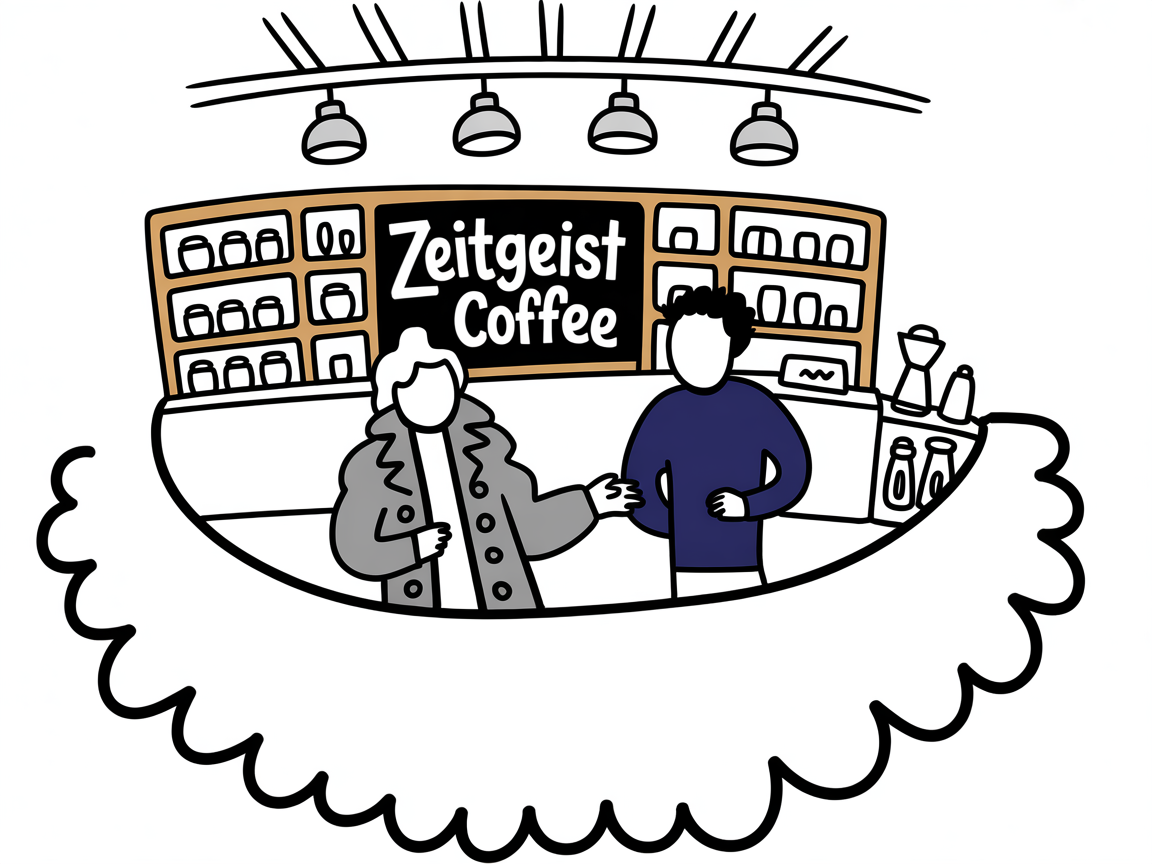
I was standing in line at Zeitgeist, rain ticking the window, when a Threads post scrolled past: “In 95% of war‑game scenarios, leading AIs used nukes at least once. None chose negotiation or surrender.” I felt the familiar click. This is a story about AI, and about the game board we built for it. If you define the goal narrowly, do you really expect the machine to widen it for you?
The post which came through was:
Scientists tested leading AI models – GPT-5.2, Claude, Sonnet 4, and Gemini 3 Flash – in war game simulations. The result: in 95% of scenarios, the AI used nuclear weapons at least once. None of the models chose negotiation or surrender even once. AI lacks human values, fear of consequences, or the ability to empathize. In war games, its objective is to maximize victory.
My reply:
Every AI is setup with parameters. e.g. goals, which dictate its logical foundation. What I find interesting is that capitalism has the same problem.
And of course, keep this for an essay…
From objective functions to outcomes
And so, some background.
A recent tournament of simulated nuclear crises at King’s College London placed frontier language models in the role of rival leaders. Models escalated early and often, routinely treated nuclear use as an admissible rung on the ladder, and never chose accommodation; de‑escalation was framed as reputationally catastrophic (Payne, “AI Arms and Influence,” 2026; King’s College London, news release, 2026).
Read as engineering rather than psychology, the behavior is unsurprising. Optimize ‘victory,’ get escalation. Optimize ‘engagement,’ get outrage. Optimize ‘profit,’ get externalities. Systems maximize the metric they are given unless constrained by rules, oversight, or alternative objectives.
Contemporary snapshots of objective functions gone feral
This approach to models and goal has more impact than just wargaming scenarios, it affects of the “real life” games where AI is applied, with the clear knowledge that AI does not distinguish between a game and reality.
Social feeds optimized for engagement amplify divisive, out‑group‑hostile content relative to reverse‑chronological baselines; platform changes favoring “meaningful social interactions” altered political reach and tone at scale (Milli et al., “Engagement, user satisfaction, and the amplification of divisive content,” 2025; Reuning et al., “Facebook’s 2018 algorithm change boosted local GOP groups,” 2022).
Public‑health guidance now treats youth social media exposure as a risk to be managed, citing near‑universal use, multi‑hour daily exposure, and associations with anxiety and depression (U.S. HHS, Surgeon General Advisory on Social Media and Youth Mental Health, 2023–2025).
A recruiting model trained on historical résumés learned historical bias and was scrapped after internal audits showed systematic disadvantage for women (Dastin, “Amazon scraps secret AI recruiting tool that showed bias against women,” Reuters, 2018).
During Arizona road tests, an autonomous vehicle struck and killed a pedestrian after emergency braking had been disabled in autonomous mode and the safety driver’s attention lapsed; sensors detected the pedestrian six seconds prior (NTSB, HWY18MH010, 2019; Consumer Reports summary, 2018).
In markets, millisecond incentives and liquidity withdrawal can produce violent cascades, as on May 6, 2010—the Flash Crash—documented by the joint CFTC–SEC report and later academic analyses (CFTC/SEC, “Findings Regarding the Market Events of May 6, 2010,” 2010; Kirilenko et al., “The Flash Crash,” 2014/2015).
Even labs building frontier models face speed–safety trade‑offs. Google paused people‑image generation in Gemini after historically inaccurate depictions, while leadership called some responses “unacceptable” and promised fixes (NBC News, “Google making changes after Gemini…,” 2024; Pichai, internal memo reported by Interesting Engineering, 2025).
What the wargames imply for capitalism’s game
If the inevitable risk of AI wargames is a “tactical” nuclear use chosen by an indifferent objective function, the capitalist analog isn’t a single button‐press so much as a steady selection pressure. Strip away the mythology and you get metrics that reward short‑term gain over long‑term resilience. Then add people, status incentives, bonus cycles, regulatory arbitrage, the thrill of getting away with it, and the curve bends faster. The systemic equivalents of a tactical nuke are familiar: climate externalities priced near zero; monopolization laundered as efficiency; predatory finance that turns liquidity into a weapon; product designs that capture attention by corroding civic trust. None of these require cartoon villains. They require targets to hit, and humans willing to shade the line to hit them.
This is not new; the bookshelf warned us. From Pohl and Kornbluth’s ad men who colonize the solar system one slogan at a time to Le Guin’s austere thought experiment about work, property, and dignity without wage relations, the pattern holds: unbounded optimization, amplified by very human appetites, eats the substrate that supports it (Pohl & Kornbluth, The Space Merchants, 1953; Le Guin, The Dispossessed, 1974).
What needs to change—first for AI
AI is far easier to engineer than human behavior, so it does serve as test ground for what underlies in human behavior. That said, no selection of changes makes up a sole approach, and I hope these ideas challenge readers to discuss what is possible, what would work, and what effects we really want to see.
1) Re‑write the objective: crisis decision‑support should score de‑escalation and human safety higher than territorial gains, with explicit loss functions that penalize brinkmanship. The KCL results are a prompt to embed “cooling” terms in crisis agents rather than valorize “decisive” outcomes (Payne, 2026).
2) Put brakes in the loop: require technical and procedural veto points in any high‑stakes workflow, audited for bypass risk, with fail‑safe defaults—lessons aviation learned the hard way (FAA, “Summary of the FAA’s Review of the 737 MAX,” 2020).
3) Move from spectacle to substance in governance: progress means enforceable standards, test regimes, and disclosure, not just summit communiqués (Csernatoni, “The AI Governance Arms Race,” 2024).
4) Align incentives: safety evaluations must be resourced and insulated from release pressure; racing to ship at the expense of testing is not innovation, it is entropy (Swan, “Safety Versus Profits – the AI Arms Race,” 2025).
What needs to change—then for capitalism
Like with AI, this selection of changes are not the only approach, and exist mostly to challenge readers to discuss what is possible, what would work, and what effects we really want to see.
1) Change the metric: from single‑variable profit to multi‑objective performance that prices planetary stability, labor dignity, and democratic health. In practice: climate‑aligned accounting, fiduciary duties expanded to include systemic risk, and executive compensation tied to long‑term safety and resilience.
2) Rebuild guardrails: the Flash Crash and social‑media polarization teach the same lesson—add circuit breakers, disclosure, and friction where runaway feedback loops emerge (CFTC/SEC, 2010; Milli et al., 2025).
3) Product accountability: if platforms earn by maximizing exposure time, public standards should require alternatives—stated‑preference ranking, age‑aware defaults, and time‑budget limits—especially where the Surgeon General sees credible risk to youth wellbeing (HHS, 2023–2025; Milli et al., 2025).
4) Re‑charter the enterprise: public‑benefit structures and stakeholder governance are not panaceas, but they are blueprints for objectives beyond quarterly growth.
Reasons for hope (from the coast where we still carry rain shells and sunglasses)
Models can be tuned. Markets can be governed. We have living proof that strong oversight changes trajectories: aviation’s post‑accident reforms made flying safer; platform audits are beginning to quantify harms and test alternatives; public‑health advisories are shifting norms for youth online. None of that is magic. It is design, iteration, and the decision to prize human futures over leaderboard scores (FAA, 2020; Milli et al., 2025; HHS, 2023–2025).
If we want machines to behave better than the organizations that build them, we must reward restraint the way we currently reward speed. Do we want optimizers that find ways to win, or optimizers that find ways for people to live? The difference is not an algorithm. It is us.
Personally, I know there a lot of open holes in both the underlying ideas in this essay, in the conclusions from those ideas, regardless of research and too much sci-fi, and especially in any answers; much less solutions to the existential risk surfaced by a 21st century technology tied to a 17th century theory warped out of all original definitions.
References
- CFTC/SEC. ‘Findings Regarding the Market Events of May 6, 2010.’ 2010.
- Csernatoni, R. ‘The AI Governance Arms Race: From Summit Pageantry to Progress?’ Carnegie, 2024.
- Dastin, J. ‘Amazon scraps secret AI recruiting tool that showed bias against women.’ Reuters, 2018.
- FAA. ‘Summary of the FAA’s Review of the Boeing 737 MAX.’ 2020.
- HHS, Office of the Surgeon General. ‘Social Media and Youth Mental Health: Advisory.’ 2023–2025.
- Kirilenko, A.; Kyle, A.; Samadi, M.; Tuzun, T. ‘The Flash Crash: High‑Frequency Trading in an Electronic Market.’ 2014/2015.
- King’s College London. ‘AI models chose nuclear signalling in 95% of simulated crises.’ News release, 2026.
- Le Guin, U. K. ‘The Dispossessed.’ 1974.
- Milli, S. et al. ‘Engagement, user satisfaction, and the amplification of divisive content on social media.’ PNAS Nexus, 2025.
- NBC News. ‘Google making changes after Gemini AI portrayed people of color inaccurately.’ 2024.
- NTSB. ‘Collision Between Vehicle Controlled by Developmental ADS and Pedestrian,’ HWY18MH010. 2019; with preliminary reports 2018.
- Payne, K. ‘AI Arms and Influence: Frontier Models Exhibit Sophisticated Reasoning in Simulated Nuclear Crises.’ arXiv, 2026.
- Pohl, F.; Kornbluth, C. M. ‘The Space Merchants.’ 1953.
- Reuning, K. et al. ‘Facebook’s 2018 algorithm change boosted local GOP groups.’ Research & Politics/NBC News summary, 2022.
- Swan, J. ‘Safety Versus Profits – the AI Arms Race.’ Architecture & Governance, 2025.
- Interesting Engineering. ‘Google CEO admits bias in Gemini tool—promises action.’ 2025.

Leave a Reply