
Part 3 of 5: Trailblazers of Today — Women Actively Shaping the Future of STEM
When conversations about women in STEM turn to role models, they often drift into mythology. We celebrate singular figures as if they emerged fully formed, untouched by institutions, politics, or resistance. I want to resist that framing here. The women highlighted in this piece matter not because they are exceptions, but because their work reshaped fields while operating within real scientific, social, and organizational constraints.
What follows is not a list of inspirational anecdotes, but a closer look at how contemporary women have altered the direction of STEM disciplines through sustained, rigorous contribution.
Jane Goodall: Redefining Scientific Method and Conservation
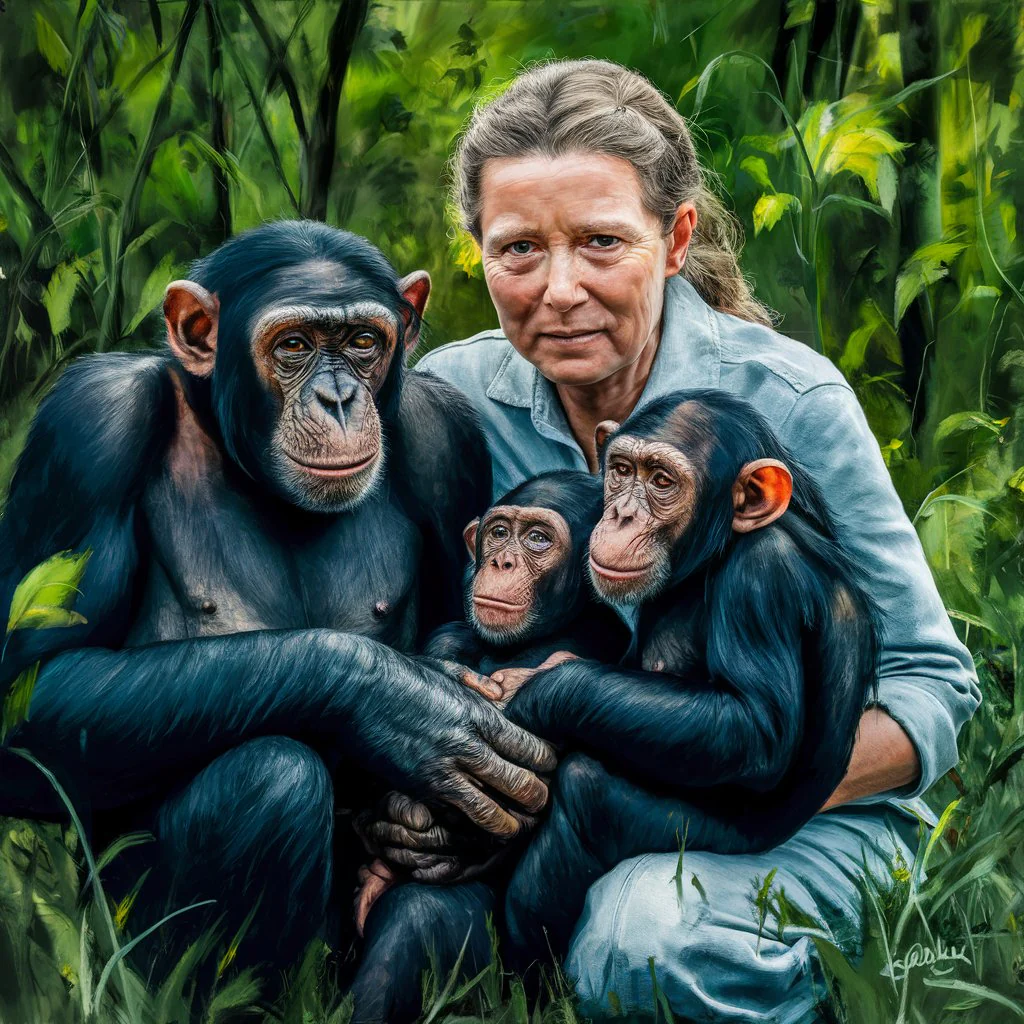
Jane Goodall’s impact on primatology is often summarized in terms of empathy or intuition, but that undersells the scientific significance of her work. Her long-term field observations at Gombe Stream National Park fundamentally changed how researchers understand primate behavior, social structure, and tool use. By documenting behaviors previously thought unique to humans, Goodall forced a revision of assumptions at the core of evolutionary anthropology (Goodall, In the Shadow of Man, 1971).
What stands out to me is that her work also challenged rigid norms about scientific method. At a time when detached observation was treated as the gold standard, Goodall demonstrated that careful, sustained engagement could generate data of extraordinary depth without sacrificing rigor. The skepticism she encountered was not just about gender; it was about who was allowed to redefine how science is done.
Her later work in conservation biology and public science communication reflects another important dimension of modern STEM: the inseparability of research from ethical and environmental responsibility. Goodall’s career illustrates that advancing knowledge and advocating for its application are not mutually exclusive (Goodall, Reason for Hope, 1999).
Mae Jemison: Interdisciplinary STEM in Practice
Mae Jemison’s career is often framed around a single milestone: becoming the first African American woman in space in 1992. That achievement matters, but focusing on it alone obscures the deeper significance of her work. Jemison’s training spans chemical engineering, medicine, and systems science, positioning her squarely in the interdisciplinary reality of modern STEM (NASA, Biographical Data: Mae C. Jemison, 2021).
From my perspective, Jemison represents a model of STEM engagement that is still underemphasized. She has consistently argued that scientific literacy, cultural context, and social responsibility are integral to technical excellence, not distractions from it. Through the Dorothy Jemison Foundation and the 100 Year Starship initiative, she has pushed for long-term, systems-level thinking about space exploration and human survival (Jemison, The 100 Year Starship, 2013).
Her work underscores an important point. Representation is not just about who occupies visible roles, but about which intellectual frameworks gain legitimacy. Jemison has expanded what counts as serious scientific inquiry.
Frances Arnold: Innovation Through Methodological Risk
Frances Arnold’s Nobel Prize–winning work in directed evolution reshaped protein engineering by embracing an approach that mimics natural selection rather than attempting to design molecular systems from first principles. This was not an obvious or universally accepted strategy when she began. It involved tolerating failure, iteration, and uncertainty at a scale many researchers avoided (Arnold, Annual Review of Chemical and Biomolecular Engineering, 2018).
What I find compelling here is that Arnold’s success came from questioning a deeply ingrained assumption: that control and prediction are always superior to exploration. Directed evolution works precisely because it leverages complexity rather than trying to eliminate it. That insight has had far-reaching applications, from green chemistry to pharmaceutical development (Nobel Prize Committee, Advanced Information, 2018).
Arnold’s career also highlights a recurring theme for women in STEM. Methodological risk is often judged differently depending on who takes it. Her persistence in pursuing an unconventional approach speaks less to individual stubbornness and more to the importance of institutional spaces that allow deviation from dominant paradigms.
Why These Examples Matter Collectively
Taken together, these women illustrate different ways of shaping STEM fields: redefining method, integrating disciplines, and reframing how innovation occurs. Their contributions are not symbolic. They altered what questions were asked, what methods were considered valid, and what outcomes were pursued.
I think it’s important to say this plainly. These women did not succeed because STEM suddenly became fair. They succeeded because they navigated unfair systems while producing work that could not be ignored. That distinction matters if we want future progress to depend less on exceptional resilience and more on structural support.
Looking Ahead
As this series continues, the focus will shift from individuals to systems. But individual stories still matter when they are used carefully. Not as proof that barriers don’t exist, but as evidence of what becomes possible when talent is allowed to persist long enough to matter.
I’d invite readers to consider whose contributions we still overlook because they don’t fit familiar narratives of genius or leadership. Whose work is collaborative, incremental, or interdisciplinary in ways that make it easier to ignore? The future of STEM will be shaped as much by who we recognize as by who we exclude.
References
Arnold, F. H. “Directed Evolution: Bringing New Chemistry to Life.” Annual Review of Chemical and Biomolecular Engineering. 2018.
Goodall, J. In the Shadow of Man. 1971.
Goodall, J. Reason for Hope. 1999.
Jemison, M. The 100 Year Starship. 2013.
NASA. Biographical Data: Mae C. Jemison. 2021.
Nobel Prize Committee. Advanced Information: The Nobel Prize in Chemistry. 2018.

Leave a Reply