
I came across https://thebestsciencefictionbooks.com/best-science-fiction-by-women about 5 weeks ago. I had read much of the list, and had to pick up a few titles like “Her Smoke Rose Up Forever” by James Tiptree, Jr (Alice Bradley Sheldon), “Sarah Canary” by Karen Joy Fowler, and “The Story Until Now” by Kit Reed.
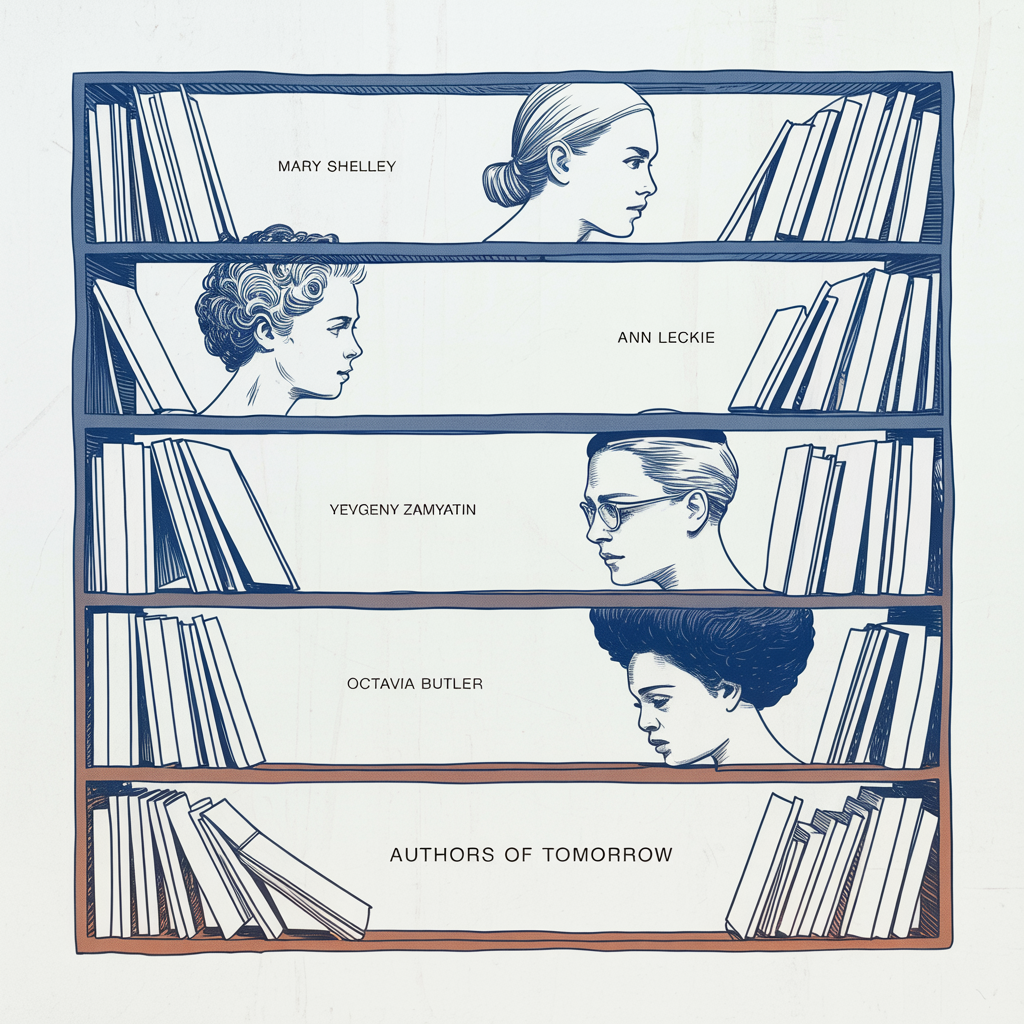
So 4 weeks later, I sat down and read the list again with a Seattle drizzle tapping the window, and I kept hearing the same quiet drumbeat beneath wildly different books: a refusal to accept inherited frames. The selections here do more than contribute to the canon; they keep reprogramming it. From Mary Shelley’s laboratory nightmare to Ann Leckie’s posthuman space opera, you can see recurring patterns in story architecture, in the tools of imagination, and in how the books talk back to their own times. The conversation is not one‑way. Women writers shape the field and then watch it reshape them in return, which is why the lineage on this list reads like a living system rather than a museum shelf (Best Science Fiction by Women, overview).
Stories, themes, and core characters: a recurring grammar of estrangement
Shelley’s Frankenstein remains the archetypal story about creation, responsibility, and ethical blowback. It ties the imaginative motor to very specific contemporary stimuli: the Geneva summer of 1816, Byron’s villa circle, and Galvani’s experiments with electricity, all explicitly foregrounded in the list’s capsule history of the novel’s inception. The result is a blueprint for techno‑moral fiction in which a maker confronts the social and personal costs of invention (Shelley, Frankenstein, 1818).
A century later, Yevgeny Zamyatin’s We transfers that ethical tension to the state, placing an engineer in a surveillance society whose love affair becomes an insurgency. The list emphasizes how We seeded later dystopias by Huxley and Orwell, which also lets us contrast women‑led interventions with male contemporaries on their own ground. Where those later novels harden into didactic parables, the women‑authored works highlighted here repeatedly complicate their own premises, turning the knife back on the reader’s assumptions as often as on their villains (Zamyatin, We, 1924; cross‑reference to Huxley and Orwell noted in the entry).
Joanna Russ’s The Female Man goes further by fracturing the protagonist into four realities, each a different political experiment in gender. The list is blunt about the book’s anger and its catalytic role in feminist SF, and that intensity is not decorative; it is a world‑building principle that shapes causality and character agency alike (Russ, The Female Man, 1975).
Octavia Butler’s Lilith’s Brood rewrites first contact so thoroughly that “aliens” and “humans” stop being stable nouns. The Oankali’s tri‑sexual biology and gene trade make persuasion, reproduction, and consent into the same problem, while post‑nuclear Earth offers the sharp historical shadow the list calls out. Butler’s survivors must negotiate not only with an other, but with the human appetite for purity that almost ended the species in the first place (Butler, Lilith’s Brood, 1987–89).
James Tiptree Jr.’s collected stories in Her Smoke Rose Up Forever are described here as singularly original and unsettling, which fits the way Alice Sheldon short‑circuits genre comfort. Cybernetic celebrity, time‑skewed all‑female futures, predatory desire re‑coded as biology: Tiptree’s core characters are pushed to edges that turn out to be mirrors, and the list’s note about mistaken assumptions of the author’s gender underlines how the stories themselves are traps for readerly bias (Tiptree, Her Smoke Rose Up Forever, 1990 collection).
Pat Cadigan’s Synners then grounds anxiety in a sensorially overloaded digital culture, where jacked‑in artists, viral code, and corporate systems blur body and network. The list calls it the “epitome of the cyberpunk thriller,” a phrase that also hints at how Cadigan reshapes a subgenre too often credited to men alone, with her focus on cognition, memory commerce, and the intimate consequences of interface rather than the swagger of cool surfaces (Cadigan, Synners, 1991).
Gwyneth Jones’s Aleutian books relocate invasion from the battlefield to the colonized psyche. The list stresses translation trouble, quasi‑immortality, and surgical self‑erasure as tools and harms of empire; the heroes here are linguists, interlocutors, and resisters caught in a long, post‑landing aftermath. This is invasion as anthropology and ethics, not spectacle, and it explicitly connects to colonial literatures beyond SF (Jones, White Queen and sequels, 1991–97).
Karen Joy Fowler’s Sarah Canary occupies a liminal slot: possibly SF, possibly not. Set in the Pacific Northwest of the 1880s, it bends frontier history into a speculative problem by making the “alien” a woman whose silence refracts the prejudices of every community she crosses. The list flags that ambiguity as the point, and from here in Seattle it reads like a reminder that speculative thinking is a regional language too: logging camps, asylum wards, and fog‑shrouded rivers as laboratories for how we see the human (Fowler, Sarah Canary, 1991).
Ann Leckie’s Ancillary Justice closes the loop by making point of view itself a technology. Breq is a human body that used to be many bodies, all shards of a ship AI. The list highlights the novel’s awards and its focus on a civil war within a single ruler, but the deeper pattern is a return to Shelley’s question of responsibility reframed as distributed cognition. When the self is a federated system, what does accountability even look like (Leckie, Ancillary Justice, 2013)?
Sub‑genres and technologies: from laboratories to languages
A clear trendline runs from laboratory gothic to social‑technical systems. Shelley’s galvanism is hardware. Russ and Butler pivot toward biopolitics, using reproduction and engineered bodies to pry open structures of power. Tiptree, Cadigan, and Leckie treat consciousness as the primary machine, with avatars, memory markets, and shipminds shifting the action inward even as the stakes remain geopolitical. Jones and Fowler press further, treating language, translation, and silence as the most consequential technologies in the room (Shelley; Russ; Butler; Tiptree; Cadigan; Jones; Fowler; Leckie).
Across these works, the “tool” of choice is often the one that destabilizes the boundary we came to protect. Parthenogenesis in The Female Man collapses patriarchal inheritance. Oankali gene exchange collapses species exceptionalism. Synaptic access in Synners collapses the line between perception and manipulation. An ancillary cohort collapses the sovereign individual into a plural subject. If you’re tracking SF’s evolution, this is not a detour; it’s the main road of the last half‑century (Russ, 1975; Butler, 1987–89; Cadigan, 1991; Leckie, 2013).
Serial influence, intertext, and conversation with history
The page makes the historical threads explicit. We informs Brave New World and 1984, situating women’s SF on this list inside a running argument with male‑authored dystopias, not outside them. Frankenstein echoes into robot ethics and the cautionary logic of creation myths across the genre. Butler’s post‑nuclear reset converses with Cold War catastrophe narratives even as it subverts their purity politics with hybrid futures. Cadigan’s information‑saturated Los Angeles registers the early 1990s media storm; Jones’s colonization cycle reads like SF’s reckoning with the legacies of empire, not just its gadgets; Fowler’s Pacific Northwest novel deepens that reckoning by reminding us how the region’s own frontier history shapes our sense of the “alien.” The list’s capsules do not treat context as trivia; they treat it as scaffolding for meaning (Zamyatin; Shelley; Butler; Cadigan; Jones; Fowler).
When we compare to male contemporaries, the differences sharpen. The entry for We itself draws the line to Huxley and Orwell, which helps frame a broader contrast: many of the women’s books here don’t simply diagnose control systems; they interrogate complicity within intimate relationships, kinship, and embodiment. Surveillance is not just a camera; it is a reproductive norm, a neural pipeline, a pronoun. That emphasis shifts the center of gravity from institutional critique to lived negotiation, without abandoning the former (Zamyatin and successors; Russ; Butler; Cadigan; Leckie).
Patterns and trends over time
Two arcs stand out. First, an expanding definition of “technology.” Electricity energizes dead flesh; later, technology is code, language, social protocol, or even the legal scaffold around reproduction. Second, a steady move from exceptional heroes to distributed agency. Breq’s “I” used to be a chorus. Aleutian colonization is survived by coalitions and translators. Butler’s hybrids are the future because no one lineage can claim survival alone. I find that shift honest to our moment, where climate, computation, and bioengineering force collective answers more than lone saviors (Shelley; Jones; Butler; Leckie).
Three questions the books press on us
What happens to responsibility when minds, bodies, and histories are networked rather than singular, and can we still speak of guilt and consent in the old ways (Leckie; Butler)?
If colonization is as much a project of language and desire as of armies, what does resistance require beyond firepower, and who gets to translate whom (Jones; Fowler)?
When our tools are intimate enough to become us, how do we draw a line between freedom and self‑erasure, especially in cultures that market memory, identity, and connection as consumables (Cadigan; Tiptree; Russ)?
Reading forward: prediction, misprediction, and the now
The list describes Synners as a vision “far too close to reality today,” and from the vantage of 2026 that feels understated. Ubiquitous feeds and the creep of brain‑computer interface research make Cadigan’s neural commerce feel less like prophecy than risk assessment. Tiptree’s “plugged‑in” celebrity and sexual obsession with the alien read like case studies in parasocial relationships and algorithmic desire. Butler’s gene politics and hybrid ethics map directly onto CRISPR debates and reproductive justice, while Leckie’s plural subject raises questions we are just beginning to face in multi‑agent AI systems and collective decision tools in governance. Shelley’s creator–creation bind now lives in every conversation about alignment and accountability in machine learning. These writers didn’t just anticipate technologies; they anticipated the human problems those technologies would exacerbate (Cadigan, 1991; Tiptree, 1990 collection; Butler, 1987–89; Leckie, 2013; Shelley, 1818).
I’ll be direct. If you grew up on space navies and killer apps, this list asks you to widen the aperture. The through line in these books is not novelty for its own sake; it is a habit of taking power’s smallest gears seriously. Gender, language, memory, kinship, law, skin, and signal: these are the levers. And once you see the pattern, you start spotting where it continues in today’s pages and screens.
References
- Best Science Fiction by Women. “The 25 Best Science Fiction Written By Female Authors.” The Best Science‑Fiction Books. Accessed Feb. 13, 2026.
- Atkinson, Kate. Life After Life. London: Doubleday, 2013.
- Beukes, Lauren. Zoo City. Cape Town: Jacana Media, 2010.
- Burdekin, Katharine. Swastika Night. London: Gollancz, 1937.
- Burroughs, Edgar Rice. A Princess of Mars. Chicago: A. C. McClurg, 1917.
- Butler, Octavia E. Lilith’s Brood (Dawn; Adulthood Rites; Imago). New York: Warner Books, 1987–1989.
- Cadigan, Pat. Synners. London: Gollancz, 1991.
- Cavendish, Margaret. The Blazing World. London: Printed for the Author, 1666.
- Cherryh, C. J. Downbelow Station. New York: DAW Books, 1981.
- Fowler, Karen Joy. Sarah Canary. New York: Henry Holt, 1991.
- Goonan, Kathleen Ann. Queen City Jazz. New York: Tor Books, 1994.
- Hurley, Kameron. God’s War. New York: Night Shade Books, 2011.
- Jones, Gwyneth. White Queen. London: Gollancz, 1991.
———. North Wind. London: Gollancz, 1994.
———. Phoenix Café. London: Gollancz, 1998. - Kress, Nancy. Beggars in Spain. New York: William Morrow, 1993.
- Leckie, Ann. Ancillary Justice. London: Orbit, 2013.
- Moore, C. L. The Best of C. L. Moore. New York: Ballantine Books, 1975.
- Murphy, Pat. The City, Not Long After. New York: Bantam Spectra, 1989.
- Reed, Kit. The Story Until Now. Middletown, CT: Wesleyan University Press, 2013.
- Russ, Joanna. The Female Man. New York: Bantam Books, 1975.
- Saxton, Josephine. Queen of the States. London: The Women’s Press, 1984.
- Shelley, Mary. Frankenstein; or, The Modern Prometheus. London: Lackington, Hughes, Harding, Mavor & Jones, 1818.
- Sheldon, Alice (James Tiptree Jr.). Her Smoke Rose Up Forever. Burton, MI: Subterranean Press, 2004 (collecting stories originally published 1968–1986).

Leave a Reply