
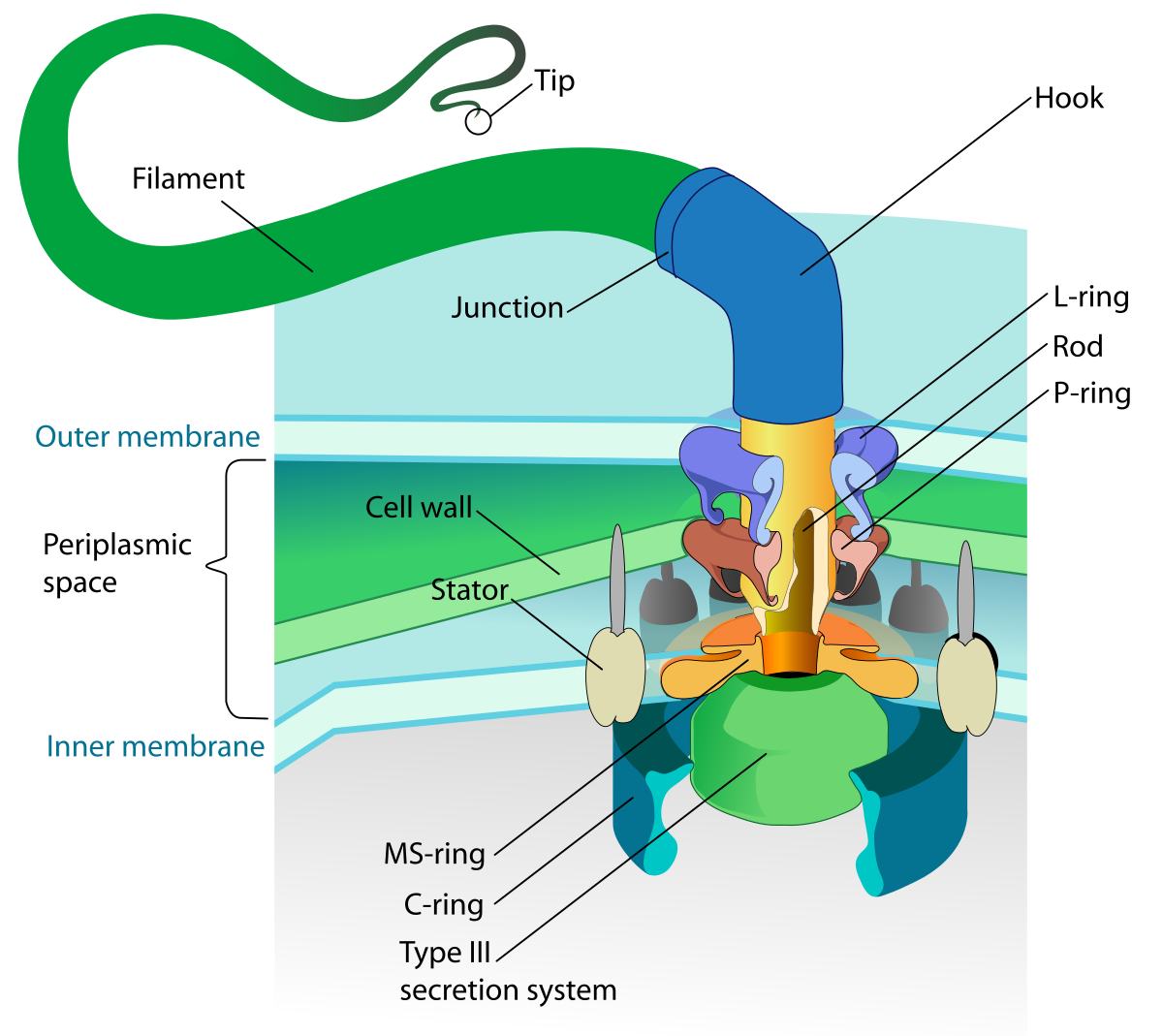
The Claim: A Molecular Machine That “Proves Design”
Intelligent Design advocates often point to the bacterial flagellum as their star witness; a microscopic rotary motor inside certain bacteria that enables movement. Posts like this one frame the argument dramatically:
“Inside some bacteria exists one of the most fascinating molecular machines known to science: the bacterial flagellar motor. It can rotate up to 100,000 RPM—five times faster than a Formula 1 engine—and reverse direction in milliseconds. This tiny rotary system powers a whip-like tail that allows bacteria to swim with precision, speed, and control in liquid environments.”
The follow-up doubles down by invoking Michael Behe’s concept of irreducible complexity, claiming that because the flagellum consists of about 30 interacting protein components, and removing any part disables the motor, it could not have evolved gradually. The argument concludes that such complexity must point to an intelligent designer.
It sounds compelling… until you examine the biology.
What Flagella Actually Are
First, flagella are not “whip-like tails” in the sense implied. They are helical filaments that rotate like corkscrews, not lashes. The apparent whipping motion seen in 2D microscopy is an optical illusion caused by rotational dynamics (Berg, The Bacterial Flagellar Motor, Annual Review of Biochemistry, 2003).
Second, there is no single “flagellar motor.” Multiple types exist, each with distinct mechanisms. For example, the proton-driven motor in E. coli differs from the sodium-driven motor in marine bacteria, and archaeal flagella (archaella) are structurally and evolutionarily unrelated to bacterial flagella; they resemble type IV pili and rotate via ATP hydrolysis rather than ion gradients (Jarrell & Albers, Nature Reviews Microbiology, 2012). These variations demonstrate evolutionary divergence, not a universal engineered blueprint.
Why This Does Not Support Intelligent Design
The claim that “a partially assembled motor does not function” ignores evolutionary pathways. The flagellar system shares homology with the Type III secretion system, a simpler apparatus used by bacteria to inject proteins into host cells. This is a classic case of exaptation, where existing structures acquire new functions through incremental modifications (Pallen & Matzke, Nature Reviews Microbiology, 2006). Evolutionary models explain how complexity arises without invoking foresight: intermediate stages confer selective advantages, even if not fully optimized for motility.
The leap from “complexity” to “design” is unfalsifiable. Complexity alone is not evidence of intentionality; it is a predictable outcome of cumulative selection acting on variation over deep time. Intelligent Design offers no testable predictions, no mechanistic models, and no empirical framework. That’s why it was ruled pseudoscience in Kitzmiller v. Dover (2005); not because of ideology, but because it fails the basic criteria of science.
What Intelligent Design Would Need to Do
If proponents want Intelligent Design to be considered science, they must do what evolutionary biology does every day: produce a predictive model, define a mechanism, and offer a falsifiable hypothesis. Show how design can be distinguished from natural processes using empirical markers. Demonstrate, with peer-reviewed evidence, that the bacterial flagellum cannot evolve through known mechanisms. Intelligent Design has never met this standard.
Until then, what’s being offered is not science, it’s apologetics dressed in engineering metaphors.
For Sideline Readers
This debate illustrates the difference between evidence-based reasoning and rhetorical framing. Science explains flagellar diversity through comparative genomics, structural biology, and evolutionary theory. Intelligent Design asserts “it looks engineered” without offering a single falsifiable hypothesis. Wonder is not evidence.
Key References:
• Berg, H.C. “The Bacterial Flagellar Motor.” Annual Review of Biochemistry, 2003.
• Jarrell, K.F., & Albers, S.V. “The Archaellum: An Archaeal Flagellum.” Nature Reviews Microbiology, 2012.
• Pallen, M.J., & Matzke, N.J. “From The Origin of Species to the Origin of Bacterial Flagella.” Nature Reviews Microbiology, 2006.
• Kitzmiller v. Dover Area School District, 400 F. Supp. 2d 707 (M.D. Pa. 2005).
Note: this is also posted in groups, but I’m not able to rely on admins to approve content.

Leave a Reply