
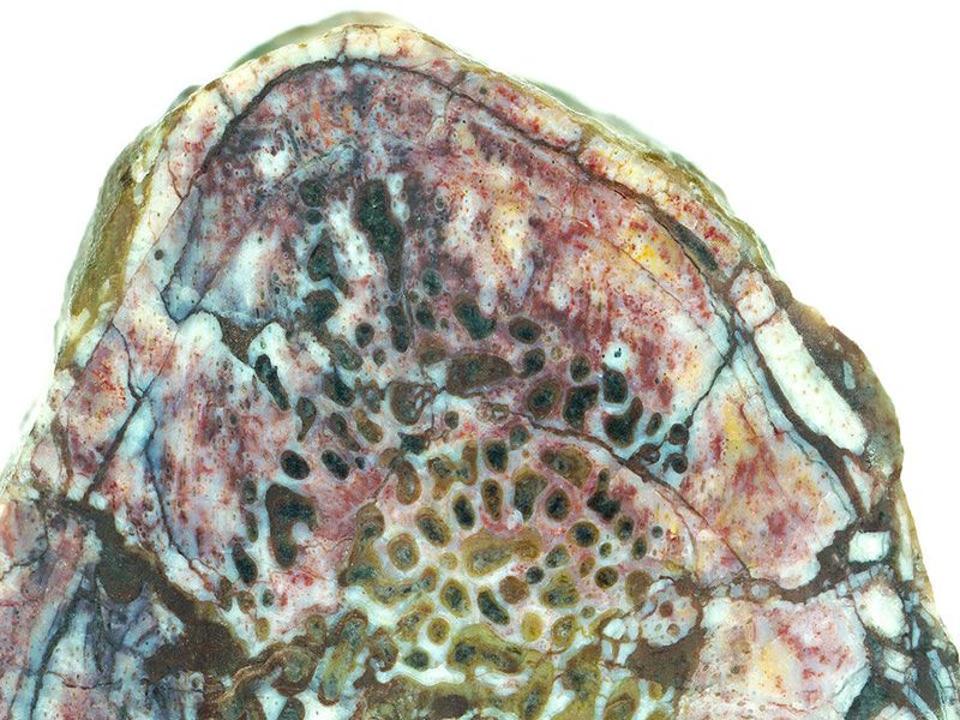
Every time someone insists “soft tissue can’t survive millions of years,” paleontology quietly drops another surprise on the table. Back in the 2000s, Dr. Mary Schweitzer stunned the field by uncovering T. rex soft‑tissue structures, flexible, vessel‑like remnants stabilized by iron rather than anything remotely “fresh.” It didn’t rewrite the age of the Earth; it just forced everyone to admit that deep‑time preservation is a lot stranger and more creative than the old textbooks made it sound.
Fast‑forward to 2025, and Rogoff & Ullmann push that boundary even further with Devonian soft‑tissue microstructures preserved in iron‑rich deposits, nearly 100 million years older than Schweitzer’s T. rex work. We’re talking vessel‑shaped traces, osteocyte‑like structures, and fibrous bone matrix that’s been chemically altered but still recognizable. It’s some of the strongest evidence yet that iron‑mediated preservation isn’t a fluke; it’s a legitimate deep‑time pathway.
And this is the part people miss: these discoveries don’t “break” paleontology. They refine it. They show that fossilization isn’t one single process but a whole toolbox of chemistries, some of which can stabilize microscopic structures far longer than anyone expected. This is what science in action actually looks like, an unexpected result, a testable mechanism, and new data that expands the story instead of blowing it up.
Schweitzer opened the door. Rogoff & Ullmann widened it. And paleobiology now has a richer, more accurate picture of how life leaves traces across hundreds of millions of years. The Earth stays old. Evolution stays intact. And the chemistry just keeps getting cooler.

Leave a Reply